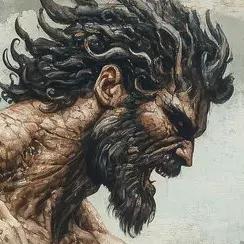
Chaos
Greek: Χαος or Χαεος.
It would seem trite to present an image of Chaos.
The ancient Greeks described the goddess Chaos (Χαος) as the personification of primordial emptiness, the space that existed before time. Chaos is not a goddess, or not just a goddess anyway. She is a place, a state of being, the first thing to ever exist. Chaos played a fundamental, foundational role in the creation of our entire universe. Chaos teaches us that emptiness is a necessary state, a smaller part of the greater cosmos.
Chaos was the lower atmosphere which surrounds the earth–both the invisible air and the gloom of fog and mist. The word chaos means “gap” or “chasm” being the space between heaven and earth. Chaos was the mother and grandmother of the other misty essences–Erebos (the mists of netherworld darkness), Aither (the ethereal mists of heaven), Nyx (the night) and Hemera (the day), as well as the numerous emotion-driving Daimones (Spirits) which haunted it. She was also a goddess of fate like her daughter Nyx and grand-daughters the Moirai (Moirae).
As the goddess of the air Chaos was also the mother of birds, just as Gaia (the Earth) was the mother of land animals, and Thalassa (the Sea) was the mother of fish.
Late classical authors redefined Chaos as the chaotic mix of elements which existed in the primordial universe, conflating it with the primal “Mud” of the Orphic cosmogony (a peculiar branch of Greek mythology). The modern English word “chaos” derives from this.